|
|
|
|
|
|
|

|
SPECIAL
FEATURES
SECTIONS
SPECIAL
FEATURES
|
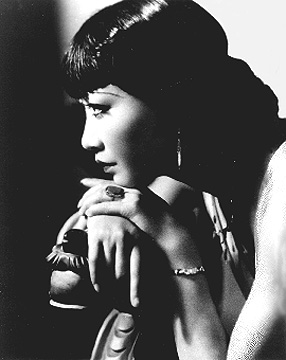
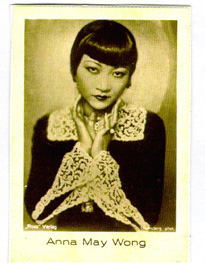
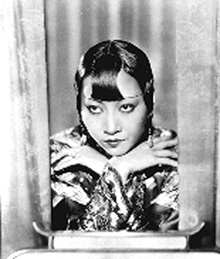
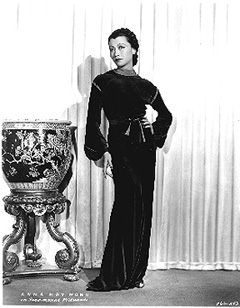
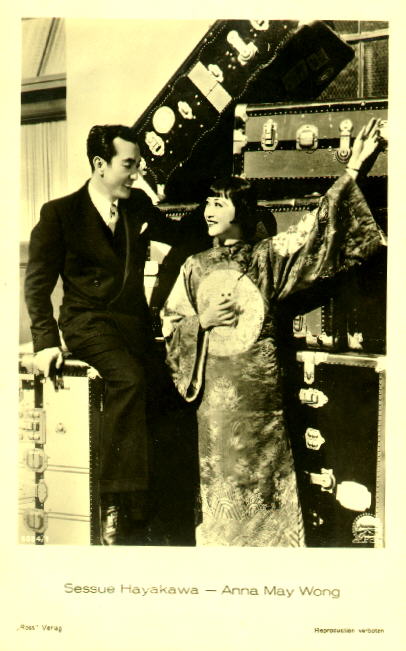
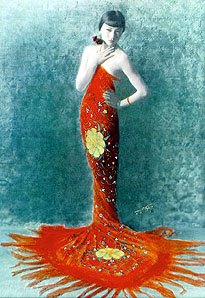
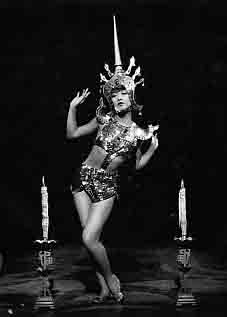
FIRST ASIAN AMERICAN STAR!
Her complexion was described as "a rose blushing through
old ivory;" she was beautiful, tall (5'7"), slender, and Chinese-American.
The last fact kept her from attaining the highest echelon among Hollywood's
pantheon of stars, but it did not affect her popularity, nor keep her from
becoming a household name.
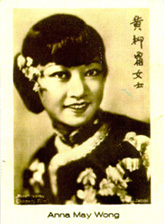
She was Anna
May Wong, nee Wong
Liu Tsong, a name which translates to "Frosted
Yellow Willows," and she
was born, appropriately enough, on Flower Street in Los Angeles' Chinatown
on 3 January 1905, above her father's laundry.
A precocious child, early on she
became fascinated with the "flickers," and would spend much of her spare
time in nickelodeons watching the shadowy images which flashed on the
screen, larger than life, in stirring melodramas or rambunctious comedies.
Besides, there was plenty of filming going on in the streets of Los Angeles
- the movie industry had created a boom town and Anna May loved to hang
around the sets on location. On the screen, her favorite male star was
Crane Wilbur, Pearl White's leading man in The Perils of Pauline (Pathe,
1914). (Interestingly, she would co-star with Wilbur on Broadway in 1930-31.)
Her two favorite female stars were cowgirl/stuntwomen Pearl White and
Ruth Roland.
Her tradition-bound father, Wong
Sam Sing, strongly disapproved of Liu
Tsong's preoccupation with the movies, which kept her
from her studies. It eventually became a losing battle when the attractive
youngster
landed a bit part in the Nazimova film The Red Lantern, (Nazimova Productions,
for Metro Pictures, 1919).
Finally, in September of 1921,
with the release of Bits of Life (Marshall Neilan Productions,for Associated
First National Pictures), the first anthology film, Anna May Wong's name
first appeared before the public. In the episode entitled Hop, the adolescent
actress played the wife of Lon Chaney's character, who bore a strong resemblance
to her own father. It was directed by the talented Marshall Neilan, who
had recognized the special qualities of this young hopeful when he had
cast her previously in a bit role for Dinty (Associated First National
Pictures, 1920). Unfortunately, Bits of Life is a lost film and Dinty
only survives in three of seven reels.
Anna
May's next credit was another supporting
role, in the John Gilbert vehicle, Shame (Fox Film Corp., 1921). The budding
beauty got her first big break the following year, when she starred in
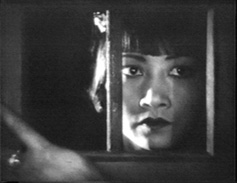
The Toll of the
Sea (Technicolor Motion Picture Company, for Metro Pictures, 1922),
the first true Technicolor feature to be made in Hollywood.
She gave a remarkably mature and
restrained performance in this variation on Madame Butterfly. Receiving
a good deal of attention, the film made money and should have started
Anna May on a starring career, but instead she followed it with supporting
roles in a lurid melodrama directed by Tod Browning, Drifting (1923) and
the western Thundering Dawn (1923), both for Universal.
One result of her work in The
Toll of the Sea
was her being chosen by Douglas Fairbanks for the part of the Mongol Slave
in his lavish fantasy, The Thief
of Baghdad (United Artists, 1924). While only a supporting role, it
was an important one, and garnered more laurels for Anna May, but still
no offers for leads.
The still teen-aged actress never
lacked for work; despite appearing only in supporting roles, she appeared
in everything from a serial, The Fortieth Door (Pathe, 1924) to two-reel
comedies, The Honorable Mr. Buggs (Pathe/Hal Roach, 1927) in the next
few years. Although she also appeared in Paramount's sparkling version
of J.M. Barrie's perennially popular Peter Pan (Famous Players-Lasky,
1924) as "Tiger Lily, Chieftainess of the Indians," the part called for
only a few scenes.
The year 1925 saw Anna May as
a dancer in a play in a Technicolor sequence near the beginning of His
Supreme Moment (Samuel Goldwyn Productions, for First National), a Ronald
Colman vehicle produced by Samuel Goldwyn, and as a vamp in the Raymond
Griffith comedy, Forty Winks (Famous Players-Lasky/Paramount).
The following year brought more
undistinguished roles, but included a film with a checkered and mysterious
history. The Silk Bouquet was produced by an outfit called Fairmont Productions
and released in June. In January of 1927, the title was changed to The
Dragon Horse and was not heard of again. The director and most of the
cast are unknown. From the two titles, it can be conjectured that this
is an all-Chinese production, made specifically for Chinese audiences,
much as the "race movies" made for all-black audiences. Accurate records
of race films are scarce to none.
In 1927 Anna
May ran the gamut of studios, from Tiffany to M-G-M, as she added
to her list of credits. Her best films that year were Mr. Wu for M-G-M,
starring Lon Chaney and Rene Adoree, who were made-up to look Asian, and
Warner Bros.' Old San Francisco, a melodrama which also featured Dolores
Costello, Warner Oland, and the San Francisco earthquake of 1906.
It was at the latter studio the
next year that the ambitious Asian lady became fed up with Hollywood.
For years, heavily
made-up Caucasian actors had been playing Asians on screen, but recently,
a young redhead from Montana seemed to be cornering the market in those
roles. So when Anna May was cast in support of Myrna Loy in The Crimson
City (Warner Bros., 1928), it was the last straw for the twenty-three-year-old
Chinese beauty. Like other talented non-whites before her, she made the
move to more tolerant Europe.
To read what happens to her when
she moved to Europe and eventually returned back to the U.S., please click
HERE.
Anna's
biggest disappointment professionally occurred
during this period. It was losing a part in MGM's great film The Good
Earth. She
tested extensively for the roles of Paul Muni's wife, O Lan, and
that of his concubine. The parts were eventually played by Luise Rainer
and Tillie Losch respectively. Rainer won the Academy Award for 1937 for
her terrific performance as O Lan.
In 1960 producer Ross Hunter cast
her in Flower Drum Song. However, Anna became ill in December of 1960
and was replaced by Juanita Hall. For the next six weeks, Anna was under
constant doctor's care, receiving liver injections each week from her
physician.
In
1943 it was proposed that she star in
a biography of Madame
Chiang Kai- Shek, but no film materialized.
On February 3, 1961, her brother
Richard summoned the doctor to their home. The doctor arrived at 3 PM
and pronounced Anna dead from a massive heart attack. It was revealed
that since 1950 she had been suffering from Laennac's cirrhosis. The disease
of the liver is caused by an over indulgence in alcohol.
As a final note: Anna May Wong
is "A Legacy Yet To Be Rediscovered"
Anna May Wong's contribution to
show business is a unique one; she was the first Asian female to become
a star, achieving that stardom at a time when bias against her race was
crushing. With determination and talent allied to her exotic beauty, she
remained the only Asian female star throughout her forty-year career,
never fully overcoming all prejudices in maintaining that position. Perhaps
the rediscovery of her art will elevate her star to the pantheon of great
performers and serve as a guiding light to Asian performers who still
struggle to find their rightful place.
Her official website can be found
HERE,
Robert Payne's illuminating article (click HERE
& go to the "Arts and Entertainment" section) and
a review of Toll
of the Sea provides invaluable perspectives on her career.
A straight-ahead biography on
her can be viewed by clicking HERE.
A listing of her fifty-four (54) films are listed
HERE.
She also starred on Broadway in "On the Spot" and on the London stage
in " A Circle of Chalk."
If you want to hear how
Anna
May Wong felt about her career, background and her life in general,
just click HERE.
You will be amazed how life hasn't CHANGED since the time
that she was acting. Just note television's lack
of diversity that still exists in the 21st century, despite the efforts
of the Asian Pacific American Media Coalition, and the prevailing Asian
stereotypes that exists in films such as Romeo
Must Die! Anna May
Wong's life and career is something that is important for all who value
greatly the Asian / Asian Pacific American communities' many artists and
what we can all contribute!
Click HERE
to read abuut an upcoming film on Anna May Wong.
FILMOGRAPHY
AND DESCRIPTION The
Red Lantern. Metro 1919. Directed
by Albert Capellani. With Alla Nazimova, Margaret McWade, Virginia Ross,
Frank Currier, Winter Hall, Amy Veness, Darrell Foss, Noah Beery, Sr.,
Harry Mann, Yukio Aoyamo, Edward J. Connelly, Anna May Wong. Anna May
Wong has a "bit." Dinty. Assoc. First National
1920. Directed by Marshall Neilan and John McDermott. With Wesley
Barry, Colleen Moore, Tom Gallery, J. Barney Sherry, Marjorie Daw, Noah
Beery, Sr., Walter Chung, Pat O'Malley, Kate Price, Tom Wilson, Aaron
Mitchell, Newton Hall, Yung Hipp, Hal Wilson, Anna May Wong. Anna May
Wong as "Chinatown resident." The First Born. Robertson
Cole 1921. Directed by Colin Campbell. With Sessue Hayakawa,
Helen Jerome Eddy, Sonny Boy Warde, Goro Kino, Marie Pavis, Clarence Wilson,
Frank M. Seki, Anna May Wong. Shame. Fox 1921.
Directed by Emmett J. Flynn. With John Gilbert, Mickey Moore, George Siegmann,
William V. Mong, George Nicholas, Anna May Wong, Rosemary Theby, Doris
Pawn, Red Kirby. Anna May Wong as the Lotus Blossom. Bits of Life. Assoc. First
National 1921. Directed by Marshall Neilan. With Wesley Barry,
Rockliffe Fellowes, Lon Chaney, Sr., Noah Beery, Sr., Anna May Wong, John
Bowers, Teddy Sampson, Dorothy Mackaill, Edythe Chapman, Frederick Burton,
James Bradbury, Jr., Tammany Young, Harriet Hammond, James Neill, Scott
Welsh. Anna May Wong as Toy Sing, wife to Chaney character. The Toll of the Sea. Metro
1922. Directed by Chester M. Franklin. With Anna May Wong, Kenneth
Harlan, Beatrice Bentley, Baby Marion, Etta Lee, Ming Young. Anna May
Wong as Lotus Flower, a suicide. Clearly inspired by Madame Butterfly,
THE TOLL OF THE SEA provided Wong with her first starring role. Lotus
Flower, a beautiful Chinese maiden, rescues a young American when he washes
ashore. The two begin a doomed affair that results in the birth of their
son. For Wong, Lotus Flower was the first of many tragic heroines she
would eventually play—Asian women who would pay the ultimate price
for their love affairs with white men. Wong’s luminous beauty, expressive
face and masterful acting abilities were already evident here, at the
young age of 17. This was the first feature film produced in the two-color
Technicolor process. Drifting. Universal 1923.
Directed by Tod Browning. With Priscilla Dean, Matt Moore, Wallace Beery,
J. Farrell MacDonald, Rose Dione, Edna Tichenor, Anna May Wong, William
V. Mong, Bruce Guerin, Marie De Albert, William Moran, Frank Lanning.
Anna May Wong as Rose Li, daughter of sinister doctor played by Mong. Thundering Dawn. Universal
1923. Directed by Harry Garson. With Winter Hall, J. Warren Kerrigan,
Anna Q. Nilsson, Tom Santschi, Charles Clary, Georgia Woodthorpe, Richard
Kean, Edward Burns, Winifred Bryson, Anna May Wong. Anna May Wong as "Honky
Tonk Girl." Lillies of the Field. Assoc.
First National 1924. Directed by John Francis Dillon. With Corinne
Griffith, Conway Tearle, Alma Bennett, Myrtle Stedman, Crauford Kent,
Sylvia Breamer, Charlie Murray, Phyllis Haver, Cissy Fitzgerald, Edith
Ransom, Charles Gerrard, Dorothy Brock, Mattie Peters, Anna May Wong. The Thief of Bagdad. United
Artists 1924. Directed by Raoul Walsh. With Douglas Fairbanks,
Julane Johnston, Snitz Edwards, Charles Belcher, Anna May Wong, Winter
Blossom, Etta Lee, Brandon Hurst, Tote Du Crow, Sojin, Noble Johnson,
Sadakichi Hartmann, K. Nambu, Mathilde Comont, Charles Stevens, Sam Baker,
Jess Weldon, Scott Mattraw, Charles Sylvester. Anna May Wong as the Mongol
slave. The Fortieth Door. Pathé
serial 1924. Directed by George
B. Seitz. With Allene Ray, Bruce Gordon, David Dunbar, Anna May Wong,
Frances Mann, Frank Lackteen, Lillian Gale, Bernard Seigel, Scott McGee,
Chief Whitehorse, Omar Whitehead, Eli Stanton. Anna May Wong as Zira. The Alaskan. Paramount
1924. Directed by Herbert Brenon. With Thomas Meighan, Estelle
Taylor, John Sainpolis, Frank Campeau, Anna May Wong, Alphonse Ethier,
Maurice Cannon, Charles Ogle. Anna May Wong as Keok, an Eskimo. Peter Pan. Paramount 1924.
Directed by Herbert Brenon. With Betty Bronson, Cyril Chadwick, Ernest
Torrence, Virginia Brown Faire, Anna May Wong, Esther Ralston, George
Ali, Mary Brian, Philippe De Lacey, Jack Murphy. Anna May Wong as Tiger
Lily. Forty Winks. Paramount
1925. Directed by Frank Urson. With Viola Dana, Raymond Griffith,
Theodore Roberts, Cyril Chadwick, Anna May Wong, William Boyd. Anna May
Wong as Annabelle Wu, an adventuress. Fifth Avenue. PRC 1926.
Directed by Robert G. Vignola. With Marguerite De La Motte, Allan Forrest,
Louise Dresser, William V. Mong, Crauford Kent, Lucille Lee Stewart, Anna
May Wong, Lillian Langdon, Josephine Norman, Sally Long, Flora Finch.
Anna May Wong as Nan Lo, a prostitute. The Silk Bouquet/The Dragon
Horse. Hi Mark Productions. 1926 with James Leong, Anna May Wong. A Trip to Chinatown. Fox
1926. Directed by Robert P. Kerr. With Margaret Livingston, Earle
Foxe, J. Farrell MacDonald, Anna May Wong, Harry Woods, Marie Astaire,
Gladys McConnell, Charles Farrell, Hazel Howell, Wilson Benge, George
Kuwa. Anna May Wong as Ohtai. The Desert's Toll. MGM
1926. Directed by Clifford Smith.
With Kathleen Key, Chief Big Tree, Anna May Wong, Francis McDonald, Tom
Santschi, Lew Meehan, Guinn Williams. Anna May Wong as Oneta. The Chinese Parrot. Universal.
1927. Directed by Paul Leni. With Marian Nixon, Florence Turner,
Hobart Bosworth, Edward Burns, Albert Conti, Sojin, Fred Esmelton, Edgar
Kennedy, George Kuwa, Slim Summerville, Dan Mason, Anna May Wong, Etta
Lee, Jack Trent. Anna May Wong as "Nautch dancer." Driven from Home. Chadwick
1927. Directed by James Young. With Ray Hallor, Virginia Lee
Corbin, Pauline Garon, Anna May Wong, Sojin, Melbourne MacDowell, Margaret
Seddon, Sheldon Lewis, Virginia Pearson, Eric Mayne, Alfred Fisher. Mr. Wu. MGM 1927.
Directed by William Nigh. With Lon Chaney, Sr., Louise Dresser, Renee
Adoree, Holmes Herbert, Ralph Forbes, Gertrude Olmstead, Mrs. Wong Wing,
Anna May Wong, Sonny Loy, Claude King. Anna May Wong as Loo Song. Old San Francisco. Warner
Bros. 1927. Directed by Alan Crosland. With Dolores Costello,
Warner Oland, Charles Emmett Mack, Josef Swickard, John Miljan, Anders
Randolf, Sojin, Angelo Rossitto, Anna May Wong. Anna May Wong as "girl." Why Girls Love Sailors.
Pathé short 1927. Directed
by Fred L. Guiol. With Stan Laurel, Oliver Hardy, Bobby Dunn, Anna May
Wong, Sojin, Eric Mayne. Anna May Wong as Delamar. The Devil Dancer. United
Artists 1927. Directed by Fred Niblo. With Gilda Gray, Clive
Brook, Anna May Wong, Serge Temoff, Michael Vavitch, Sojin, Uta Mita,
Ann Schaeffer, Albert Conti, Clarissa Selwynne, James Leong, Martha Mattox,
William H. Tooker, Claire Du Brey, Nora Cecil, Barbara Tennant, Kalla
Pasha. Anna May Wong as Sada. Streets of Shanghai. Tiffany
1927. Directed by Louis Gasnier. With Pauline Starke, Kenneth
Harlan, Eddie Gribbon, Margaret Livingston, Jason Robards, Sr., Mathilde
Comont, Anna May Wong, Sojin, Tetsu Komai, Toshyie Ichioka, Media Ichioka.
Anna May Wong as Su Quan. Pavement Butterfly (aka
City Butterfly). Grossstadt-Schmetterling/Germany 1928. Directed
by Richard Eichberg. Screenwriter: Hans Kyser. Based on the novel by Adolf
Lantz. Cinematographers: Heinrich Gärtner, Otto Baecker. With: Anna
May Wong, Louis Lerch, Alexander Grananch, E. F. Bostwick, 35mm, silent
with English intertitles, 90 min. (24 fps). Love, lust, greed and art
don’t mix well in this silent melodrama that moves from the circus
to bohemian artists’ studios to the French Riviera. In her second
film with Richard Eichberg, Wong plays Mah, the star performer in a circus
acrobatic act. When fellow performer Koko murders Mah’s partner,
she is blamed for his death and forced to flee. Mah finds work modeling
for a handsome artist and soon falls in love with him. But the lascivious
Koko follows her, worsening her predicament as she tries to clear her
name. Though she was praised for her part, some critics claimed that Wong,
shown stylishly dressed in contemporary fashions, wasn’t portrayed
as “exotic” enough. In
the fall of 1997, Bowdoin College in Maine presented the world
premiere of "China Doll," a play by Elizabeth Wong (no
relation to the actress). "China Doll" explores the
life and career of Anna May Wong, especially the limitations imposed
on her as an actress of Chinese decent. The play
combines real events and people from Anna May's life with other
imagined scenes and characters, creating what the playwright describes
as "an exploration of the mysteries of love - the love of
work, the love of artistic pursuit, the love of men, the love
of movies." Across to Singapore. MGM
1928. Directed by William Nigh.
With Ramon Novarro, Joan Crawford, Ernest Torrence, Frank Currier, Dan
Wolheim, Duke Martine, Edward Connelly, James Mason, Anna May Wong. The Crimson City. Warner
Bros. 1928. Directed by Archie Mayo. With Myrna Loy, John Miljan,
Leila Hyams, Matthew Betz, Anna May Wong, Anders Randolf, Richard Tucker,
Sojin. Anna May Wong as Su. Chinatown Charlie. First
National 1928. Directed by Charles Hines. With Johnny Hines,
Louise Lorraine, Harry Gribbon, Fred Kohler, Sr., Scooter Lowry, Sojin,
Anna May Wong, George Kuwa, John Bradette. Anna May Wong as Mandarin's
(played by Sojin) sweetheart. Song. German 1928.
Directed by Richard Eichberg. Producer: R. Eichberg. Scenarists: Helen
Gosewish, Adolf Lantz. Based on the novel Dirty Money by Karl Vollmöller.
Cinematographers: Heinrich Gärtner, Bruno Mondi. Editor: Alfred Booth.
With Anna May Wong, Heinrich George, Hans Adalbert, Paul Horbiger. In
the late 1920s, Wong sailed for Europe, hoping to escape the stereotyped
roles being offered her in Hollywood. In her first film with German director
Richard Eichberg, Wong plays Song, a down-on-her-luck Malayan dancer who
becomes involved with a mysterious knife-thrower after he saves her from
two thugs. They form a successful act on their own, and Song soon falls
for her partner until the return of his former lover sets off a fatal
series of events. Wong enchanted film audiences across Europe with her
masterfully subtle performance and electrifying screen presence. Anna
May Wong played the role of a Malayan who marries a brutal painter played
by George. The City Butterfly. German
1929. Directed by Richard Eichberg. With Anna May Wong, Alexander
Granach, Tilla Garden. Anna May Wong as a "sideshow dancer." Piccadilly.
British International 1929. Directed by E. A. Dupont. Producer:
E.A. Dupont. Scenarist: Arnold Bennett. Cinematographer: Werner Brandes.
Editor: J.W. McConaughty. With Gilda Gray, Anna May Wong, Jameson Thomas,
Charles Laughton, Cyril Ritchard, King Ho-Chang, Hannah Jones, Ellen Pollock,
Harry Terry, Gordon Begg, Charles Paton, Debroy Somers and his Band. In
1929, after several starring roles in Germany, the young Anna May Wong
made her way to London to star in her final
silent film and her only feature with German-born director E.A. Dupont.
In this melodrama of jealousy and murder, Wong plays a scullery maid named
Shosho who, while dancing in the kitchen, attracts the attention of her
boss and becomes the star attraction at a trendy London nightclub. Dupont
lavished Wong with close-ups and glorious costumes, allowing her to easily
upstage co-star Gilda Gray. The film also features one of the very first
onscreen performances by Charles Laughton, playing a boisterous nightclub
patron. Anna May Wong played the role of Shosho, mistress to Thomas character. Elstree Calling. British
International 1930. Directed by Adrian Brunel, Alfred Hitchcock,
Andre Charlot, Jack Hulbert, and Paul Murray. With Will Fyffe, Lily Morris,
Tommy Handley, Anna May Wong, Teddy Brown, Bobbie Comber, Hannah Jones,
Cicely Courtneidge, Jack Hulbert, Helen Burnell, Donald Calthrop, James
Thomas, Ivor MacLaren, John Longden, Berkoff Dancers, Charlot Girls, Three
Eddies, the Adelphi girls, Kasbek Singers. A revue with Anna May Wong
as herself. The Flame of Love. British
International 1930. Directed by Richard Eichberg. Producer: R.
Eichberg. Screenwriters: Monckton Hoffee, Ludwig Wolff. Cinematographers:
Heinrich Gärtner, Bruno Mondi. Editor: Emile de Ruelle. With Anna
May Wong, John Longden, George Schnell, Mona Goya, Percy Standing, Fred
Schwartz, Lay-On. Anna May Wong as Hai-tang, a dancer. Wong made her speaking
debut in this melodrama set in pre-Revolutionary Russia. Wong plays Hai-Tang,
a young Chinese dancer who falls for a Russian military officer, but their
affair is complicated when the officer’s superior sets his sights
on her. The chance to see and hear Wong in a talkie made the film a great
attraction to contemporary audiences. By 1930 Wong had toned down the
American accent that had previously moved one of her producers to comment,
“But oh! that California accent! As thick as the smog that now covers
their cities.” Wong also mastered enough German and French to play
the role of Hai-Tang in two foreign-language versions shot at the same
time, with different male leads. Hay Tang. German 1930.
Directed by Richard Eichberg, With Anna May Wong, Francis Lederer, Hermann
Blass. Anna May Wong as Hay Tang, a dancer. The German version of The
Flame of Love. L'Amour Maitre Des Choses.
French 1930. Directed by Richard Eichberg. With Anna May Wong,
Robert Ancelin, Marcel Vibert. Anna May Wong as Hai-tang. The French version
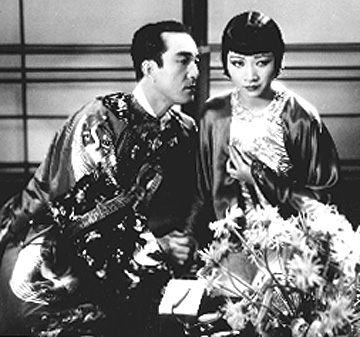
of The Flame of Love. Daughter of the Dragon.
Paramount 1931. Directed by Lloyd Corrigan. Screenwriters: L.
Corrigan, Monte M. Katterjohn. Based on the novel Daughter of Fu Manchu
by Sax Rohmer. Cinematographer: Victor Milner. With Anna May Wong, Warner
Oland, Sessue Hayakawa, Bramwell Fletcher, Frances Dade, Holmes Herbert,
Lawrence Grant, Harold Minjir, Nicholas Soussanin, E. Alyn Warren, Harry
Lee, Olaf Hytten, Nella Walker, Oie Chan, Tetsu Komai, George Kuwa. Orientalist
archvillain Fu Manchu resurfaces in London, with an undying lust for vengeance
directed at the Petrie family, whom he mistakenly blames for the death
of his wife and son. Not only is Sir John Petrie shot in his own home,
but his son Ronald is at risk of succumbing to the seductive charms of
the villain’s equally malevolent daughter Ling Moy (Wong). “Yellow
Peril” tropes abound in this fantasy of Eastern threat: wafting
incense, ominous shadows, knife clutched under ample Chinese sleeve. The
film is racist, but ironically, the film is best remembered today for
its Asian actors, Wong and Sessue Hayakawa, who bring grace, subtlety
and gravity to their stereotyped roles. Anna May Wong played the role
of Ling Moy, daughter of Fu Manchu, played by Oland. This
5'7 beauty loved to study and could speak in an English accent,
as well as being fluent in German and French with more than a passing
knowledge of other tongues including Italian and Yiddish. For
exercise she rode horses, played golf, and tennis. She liked to
cook and regaled her guests with succulent Chinese dishes at frequent
dinner parties. She
preferred casual clothes, wearing slacks and sweaters at home, but
cultivated an oriental motif in her very smart formal wardrobe.
She
studied singing with Welsh tenor Parry Jones before she participated
in the film Limehouse Blues as George Raft's mistress. Anna
loved to dance to contemporary music. Anna was quoted as saying,
"I think I got my first chance because they thought I was peculiar.
But, now I like to believe that the public are fond of me because
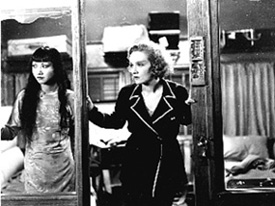
they think I'm nice." Shanghai Express. Paramount
1932. Directed by Josef Von Sternberg.
With Marlene Dietrich, Clive Brook, Anna May Wong, Warner Oland, Eugene
Pallette, Lawrence Grant, Louis Closser Hale, Gustav Von Seyffertitz,
Emile Chautard, Madame Sojin, Willie Fung, James Leong, Forrester Harvey,
Leonard Carey, Claude King, Neshida Minoru, Miki Morita. The combined
star power of Marlene Dietrich and Anna May Wong propels this melodrama
in which two former lovers are reunited on a train during the Chinese
civil war. Von Sternberg was arguably one of cinema’s greatest directors
of women, and in SHANGHAI EXPRESS he had two illustrious actresses to
work with: Dietrich, as the notorious “coaster,” Shanghai
Lily, and Wong as her traveling companion, the reformed prostitute Hui
Fei. Wong’s outstanding performance was so powerful yet so restrained,
that Dietrich felt she had been upstaged. The steam and smoke, the stylized
performances, the minimalist but crackling dialogue and the stunning cinematography
of Lee Garmes all make for a most enjoyable ride. Anna May Wong played
the role of Hui Fei, a lady of dubious morals. A Study in Scarlet. World
Wide 1933. Directed by Edwin L. Marin. With Reginald Owen, Anna
May Wong, June Clyde, Alan Dinehart, John Warburton, Warburton Gamble,
Alan Mowbray, Doris Lloyd, Billy Bevan, Leila Bennnett, J. M. Kerrigan,
Wyndham Standing, Halliwell Hobbes, Tempe Pigott, Cecil Reynolds, Tetsu
Komai. Anna May Wong as Mrs. Pyke, a crook. Tiger Bay. Associated British
1933. Directed by J. Elder Sills. With Anna May Wong, Henry Victor,
Rene Ray, Lawrence Grossmith, Victor Garland, Ben Soutten, Margaret Yarde,
Benn Williams, Wally Patch, Ernest Jay, Brian Buchel. This is one of three
British productions starring Wong released in 1934, she plays the beautiful
and heroic Liu Chang, dancer and proprietor of a rowdy cafe who fights
to save a young woman from a gang of thuggish sailors. British censors
insisted that the setting be relocated from London to the fictional South
American town of “Tiger Bay,” a port city filled with gangsters,
petty thieves, prostitutes and “all the riff-raff of the seven seas.”
(Note: Legendary British director David Lean earned one of his screen
credits as an editor on this film. Chu Chin Chow. Gaumont
1934. Directed by Walter Forde. With George Robey, Fritz Kortner,
Anna May Wong, John Garrick, Pearl Argyle, Malcolm MacEachern, Dennis
Hoey, Francis L. Sullivan, Sydney Fairbrother, Lawrence Hanray, Frank
Cochrane, Thelma Tuson, Myoshi Takase. Anna May Wong as Zahret, a slave
girl. Producer: Michael Balcon. Screenwriters: Sidney Gilliat, L. DuGarde
Peach, Edward Knoblock. Based on the musical by Oscar Asche and Frederic
Norton. Cinematographer: Mutz Greenbaum. Editor: Derek N. Twist. With:
Anna May Wong, George Robey, Fritz Kortner, John Garrick. 35mm, 93 min.
With production values luxuriant enough to rival those in Hollywood, this
British musical presents orientalist fantasy at its most glamorous and
grotesque. Inspired by The Arabian Nights, the plot revolves around the
bandit Abu Hassan, who plans to impersonate Asian merchant Chu Chin Chow
in order to sack Baghdad. Although she doesn’t have a lot of screen
time, Wong was top-billed as Hassan’s lover, Zahrat—testimony
to her box-office appeal. Though her singing was dubbed, Wong’s
talent shone in her skillful acting and sensuous dance sequences, no doubt
aided by her scintillating costumes. Limehouse Blues. Paramount 1934. Directed
by Alexander Hall. With George Raft, Jean Parker, Anna May Wong, Kent
Taylor, Montagu Love, Billy Bevan, Robert Loraine, John Rogers, E. Alyn
Warren, Wyndham Standing, Louis Vincenot, Keith Hitchcock, Forrester Harvey,
Desmond Roberts, Colin Kenny, Robert Adair, Eric Blore, Tempe Pigott,
Eily Malyon, Elsie Prescott, Colin Tapley, Rita Carlisle, Joe May, Otto
Yamaoka, Dora Mayfield, Angelo Bianchi, Ann Sheridan, Joe Glick. Anna
May Wong as Tu Tuan, the Raft character's mistress. Daughter of Shanghai. Paramount 1937.
Directed by Robert Florey. Producer: Edward T. Lowe. Screenwriters: Gladys
Unger, Garnett Weston. Based on a story by G. Weston. Cinematographer:
Charles Schoenbaum. Editor: Ellsworth Hoagland. With Anna May Wong, Charles
Bickford, Buster Crabbe, Cecil Cunningham, J. Carrol Naish, Anthony Quinn,
Philip Ahn, Evelyn Brent, John Patterson, Guy Bates Post, Frank Sully,
Fred Kohler, Sr., Virginia Dabney, Ching Way Lee, Maurice Liu, Mrs. Wong
Wing, Gwen Kenyon, Paul Fix, Ernest Whitman, Layne Tom, Jr., Gino Corrado,
Bruce Wong, Paulita Arvizu, Charles Wilson, Mae Busch, Michael Wu, Bill
Powell, Pierre Watkin, Carmen La Roux, Tina Menard, Jimmie Dundee, Carmen
Bailey, Alex Woloshin, Agostino Borgato, Billy Jones, Harry Strang, Alma
Ross, Joyce Mathews, Helaine Moler, Lee Shumway, Blanca Vischer, Norah
Gale, Paula de Cardo, Sheila Darcy, Chick Collins, Marie Burton, Harriette
Haddon. After a wealthy importer is murdered by a gang smuggling immigrant
workers into San Francisco, an Asian federal agent is sent to crack the
case. Meanwhile, the importer’s daughter (Wong) strikes out on her
own, determined to avenge her father’s death. Directed by Robert
Florey, an avant-garde auteur cum B-movie director, DAUGHTER OF SHANGHAI
is a rarity among Hollywood productions of the day—an Asian-themed
film with Asian-American actors in the lead roles. Committed to appearing
only in films with positive portrayals of Chinese characters, Wong moves
beyond the Dragon Lady role, instead adopting the persona of a classic
Hollywood heroine: she’s courageous, determined, and even gets the
guy—played by her long-time friend, Philip Ahn. Anna May Wong played
the role of Lan Ying Lin, who seeks her father's murderer.
Hollywood Party. MGM short subject 1937. With Clark Gable, Elissa Landi, Joan Bennett, Anna May Wong, Joe E. Brown, Freddie Bartholomew, Leon Errol, Joe Morrison, Betty Rhodes, Clark Gable, Joan Bennett, Elissa Landi, Charley Chase, Leon Janney. Anna May Wong and other celebrities attend a technicolored party. Dangerous to Know. Paramount 1938. Directed by Robert Florey. Producer: Edward T. Lowe. Screenwriters: William Lipman, Horace McCoy. Based on the play On the Spot by Edgar Wallace. Cinematographers: Karl Struss, Charles Schoenbaum. Editor: Arthur Schmidt. With Anna May Wong, Akim Tamiroff, Gail Patrick, Lloyd Nolan, Harvey Stephens Anthony Quinn, Roscoe Karns, Porter Hall, Barlowe Borland, Hugh Sothern, Hedda Hopper, Edward Pawley, Garry Owen, Robert Brister, Stanley Blystone, Pierre Watkin, Edward Marr, Harry Worth, Donald Brian, Ellen Drew, Rita La Roy, Harvey Clark, Jack Knoche, Margaret Randall, Rudolph Myset, Gino Corrado, Andre Marsaudon, Perry Ivins, Grace Benham, Wade Boteler, Ruth Rogers, John Hart, David Newell, Frank Melton, Ivan Miller, Larry Steers, Lynn Bailey, Sheila Darcy, Cyril Ring, Blanca Vischer, Suzanne Ridgeway, Carol Parker, Joyce Mathews, Estelle Etterre, Harry Myers. Anna May Wong as Madame Lan Ying, mistress to Tamiroff character. In her second film with Florey, Wong plays Lan Ying, the “hostess” (read: mistress) of the notorious Stephen Recka (Akim Tamiroff), a powerful Los Angeles gangster who aims to control City Hall by using corrupt politicians. Recka longs to be accepted by high society and eventually discards Lan Ying in favor of a pretty young socialite. In an emotionally wrenching scene, Lan Ying enacts the perfect revenge. The film was based on the play On the Spot, in which Wong made her American stage debut in 1930. When Were You Born? Warner Bros. 1938. Directed by William McGann, with Anna May Wong, Margaret Lindsay, Lola Lane, Anthony Averill, Charles Wilson, Jeffrey Lynn, Eric Stanley, James Stephenson, Leonard Mudie, Olin Howland, Maurice Cass, Jack Moore, Frank Jaquet, John Ridgely, Carole Landis, Peggy Moran, Edwin Stanley, Sidney Bracey, Tetzu Komai, Lottie Williams. Anna May Wong as Mary Lee Ling, an astrologist. King of Chinatown. Paramount 1939. Directed by Nick Grinde With Anna May Wong, Akim Tamiroff, J. Carrol Naish, Sidney Toler, Anthony Quinn, Philip Ahn, Roscoe Karns, Richard Denning, Bernadene Hayes, Ray Mayer, Archie Twitchell, Chester Gan, George Anderson, George Magrill, Edward Marr, Charles B. Wood, Charles Trowbridge, Robert Homans, Lily King, Pierre Watkin, Wong Chung, Alexander Pollard, Guy Usher, Pat West, Sam Ash, Larry McGrath, Charles Lee, Jimmy Vaughn, Ivan Miller, Ben Taggart, Grace Lem, David Dong, Gloria Williams, Luana Walters, Marie Burton, Judith King, Dolores Casey, Ethel Clayton, Dorothy White, Helaine Moler, Norah Gale, Gwen Kenyon, Joyce Mathews, Harriette Haddon, Florence Wix, Sheila Darcy, Dorothy Dayton, Paula de Cardo. Anna May Wong as Mary Ling, a doctor. Island of Lost Men. Paramount 1939. Directed by Kurt Newmann. With Anna May Wong, Anthony Quinn, J. Carrol Naish, Eric Blore, Broderick Crawford, Ernest Truex, Rudolph Forster, William Haade, Richard Loo, Ralph Suncuya, Torben Meyer, Lai Chand Mehra, Rupert Andez, Vivian Oakland, George Kirby, Rafael Storm, George Melford, Ethel May Halls, Ruth Rickaby, Jack Perry, Philip Ahn, Philson Ahn, C. L. Sherwood, Mitchell Ingraham, Bruce Mitchell. Anna May Wong as Kim Ling, daughter of a general.
Chinese Garden Festival. Republic short subject, 1940. One of the "Meet The Stars" series with Rosalind Russell, William Bakewell, Dorothy Lamour, Rita Hayworth, Anna May Wong, Cesar Romero, Walter Pidgeon, Rose Hobart, Patricia Morison, Gertrude Niesen, Kay Aldridge, Mary Beth Hughes, Charles "Buddy" Rogers, Mary Pickford, Jane Withers, Beulah Bondi, Vera Vague, Mary Martin, King Kennedy, Cliff Nazarro, Mary Howard, Gloria and Barbara Brewster. Jane Hamilton, Susan Peters, Ona Munson, Georgia Carroll, Mary Healy. Anna May Wong and other celebrities attend a party. Ellery Queen's Penthouse Mystery. Columbia 1941. Directed by James Hogan. With Ralph Bellamy, Margaret Lindsay, Anna May Wong, Charley Grapewin, James Burke, Eduardo Cianelli, Frank Albertson, Ann Doran, Noel Madison, Charles Lane, Russell Hicks, Tom Dugan, Manton Moreland, Theodor Von Eltz, Richard Loo, Chester Gan, Edward Earle, George McKay, Jimmy Aubrey. Anna May Wong as Lois King, a diplomat. Bombs Over Burma. PRC 1942. Directed by Josseph H. Lewis With Anna May Wong, Noel Madison, Leslie Denison, Nedrick Young, Dan Seymour, Frank Lackteen, Judith Gibson, Dennis Moore, Connie Leon, Richard Loo, Hayward Soo Hoo, Paul Fung. Anna May Wong as Lin Ying, a schoolteacher. The Lady From Chungking. PRC 1942. Directed by William Nigh, With Anna May Wong, Harold Huber, Mae Clarke, Rick Vallin, Paul Bryar, Ted Hecht, Ludwig Donath, Archie Got, James Leong, Walter Soo Hoo Anna May Wong as Kwan Mei, a guerilla leader. Impact. United Artists 1949. Directed by Arthur Lubin. With Brian Donlevy, Ella Raines, Charles Coburn, Helen Walker, Anna May Wong, Mae Marsh, Tony Barrett, William Wright, Robert Warwick, Philip Ahn, Clarence Kolb, Erskine Sanford, Linda Johnson. Anna May Wong as Su Lin, a maid. Portrait In Black. Universal 1960. Directed by Michael Gordon With Lana Turner, Anthony Quinn, Sandra Dee, John Saxon, Richard Basehart, Lloyd Noland, Ray Walston, Virginia Grey, Anna May Wong, Dennis Kohler, Paul Birch, John Wengraf, Richard Norris, James Nolan, Robert Lieb, John McNamara, Charles Thompson, George Womack, Henry Quan, Elizabeth Chan, Harold Goodwin, Jack Bryan. Anna May Wong as Tani, a housekeeper.
If you have any questions regarding the content, please contact
Asian American Artistry |
||||||||||||||||||||||||||||||||||||||||||||||||||||||||||||||||||||||||||